🚚 Free Worldwide Shipping on All Orders!Shop Now
Emanuel Law Outlines for Constitutional Law, Forty-second Edition
ABOUT THE BOOK—TOOLS TO SUCCEED
Coverage of key 2023–2024 Supreme Court developments, including:
- The Capsule Summary provides a quick reference summary of the key concepts covered in the full Outline.
- The detailed course Outline with black letter principles supplements your casebook reading throughout the semester and gives structure to your own outline.
- The Quiz Yourselffeature includes a series of short-answer questions and sample answers to help you test your knowledge of the chapter’s content.
- Exam Tips alert you to issues and commonly used fact patterns found on exams.
- The Casebook Correlation Chart correlates each section in the Outline with the pages covering that topic in the major casebooks.
Coverage of key 2023–2024 Supreme Court developments, including:
- Trump v. U.S., holding that Presidents are entitled to at least a presumption of immunity from criminal prosecution for their official acts. In some contexts, the immunity is absolute, and in others, the President benefits from a strong “presumption of immunity” that will be difficult for the prosecution to rebut.
- U.S. v. Rahimi, a Second Amendment case, holding that government may restrict certain persons from owning guns. However, the restriction must be “relevantly similar” to restrictions that existed in 1791.
- Moody v. NetChoice, LLC, indicating that government likely violates the free-expression rights of a social media platform if government enacts an “anti-censorship” rule that requires the platform to include third-party posts that the platform wants to keep off the site.
- Murthy v. Missouri, a case about standing, holding that a plaintiff does not have standing unless she can show that a favorable outcome in the suit would “redress” the harm from whatever action (usually a government action) the plaintiff is challenging.
Product Information
Product Information
Shipping & Returns
Shipping & Returns
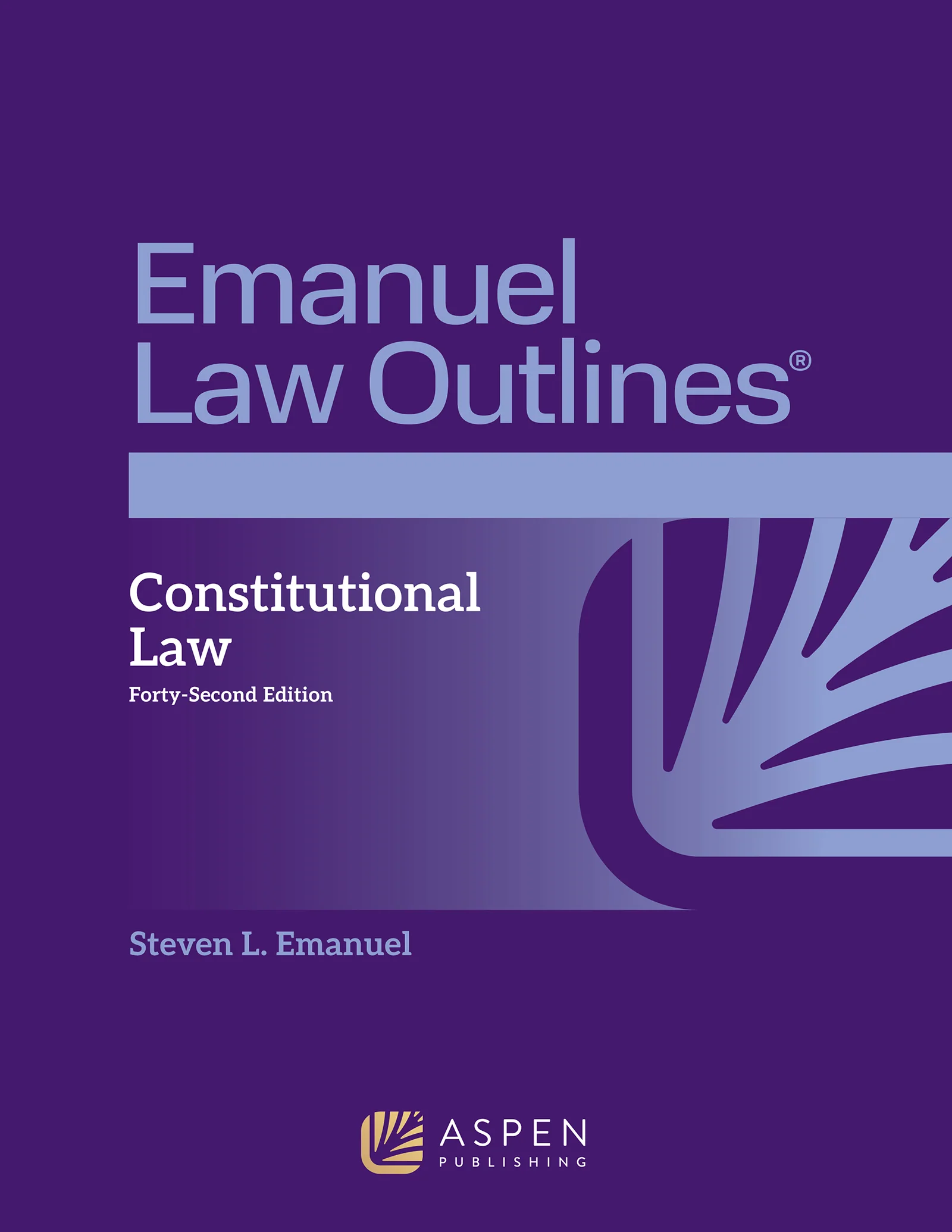
Emanuel Law Outlines for Constitutional Law, Forty-second Edition
Emanuel Law Outlines for Constitutional Law, Forty-second Edition
ABOUT THE BOOK—TOOLS TO SUCCEED
Coverage of key 2023–2024 Supreme Court developments, including:
- The Capsule Summary provides a quick reference summary of the key concepts covered in the full Outline.
- The detailed course Outline with black letter principles supplements your casebook reading throughout the semester and gives structure to your own outline.
- The Quiz Yourselffeature includes a series of short-answer questions and sample answers to help you test your knowledge of the chapter’s content.
- Exam Tips alert you to issues and commonly used fact patterns found on exams.
- The Casebook Correlation Chart correlates each section in the Outline with the pages covering that topic in the major casebooks.
Coverage of key 2023–2024 Supreme Court developments, including:
- Trump v. U.S., holding that Presidents are entitled to at least a presumption of immunity from criminal prosecution for their official acts. In some contexts, the immunity is absolute, and in others, the President benefits from a strong “presumption of immunity” that will be difficult for the prosecution to rebut.
- U.S. v. Rahimi, a Second Amendment case, holding that government may restrict certain persons from owning guns. However, the restriction must be “relevantly similar” to restrictions that existed in 1791.
- Moody v. NetChoice, LLC, indicating that government likely violates the free-expression rights of a social media platform if government enacts an “anti-censorship” rule that requires the platform to include third-party posts that the platform wants to keep off the site.
- Murthy v. Missouri, a case about standing, holding that a plaintiff does not have standing unless she can show that a favorable outcome in the suit would “redress” the harm from whatever action (usually a government action) the plaintiff is challenging.
Select Only eStore Format
From $11.90
Original: $33.99
-65%Emanuel Law Outlines for Constitutional Law, Forty-second Edition—
$33.99
$11.90Product Information
Product Information
Shipping & Returns
Shipping & Returns
Description
ABOUT THE BOOK—TOOLS TO SUCCEED
Coverage of key 2023–2024 Supreme Court developments, including:
- The Capsule Summary provides a quick reference summary of the key concepts covered in the full Outline.
- The detailed course Outline with black letter principles supplements your casebook reading throughout the semester and gives structure to your own outline.
- The Quiz Yourselffeature includes a series of short-answer questions and sample answers to help you test your knowledge of the chapter’s content.
- Exam Tips alert you to issues and commonly used fact patterns found on exams.
- The Casebook Correlation Chart correlates each section in the Outline with the pages covering that topic in the major casebooks.
Coverage of key 2023–2024 Supreme Court developments, including:
- Trump v. U.S., holding that Presidents are entitled to at least a presumption of immunity from criminal prosecution for their official acts. In some contexts, the immunity is absolute, and in others, the President benefits from a strong “presumption of immunity” that will be difficult for the prosecution to rebut.
- U.S. v. Rahimi, a Second Amendment case, holding that government may restrict certain persons from owning guns. However, the restriction must be “relevantly similar” to restrictions that existed in 1791.
- Moody v. NetChoice, LLC, indicating that government likely violates the free-expression rights of a social media platform if government enacts an “anti-censorship” rule that requires the platform to include third-party posts that the platform wants to keep off the site.
- Murthy v. Missouri, a case about standing, holding that a plaintiff does not have standing unless she can show that a favorable outcome in the suit would “redress” the harm from whatever action (usually a government action) the plaintiff is challenging.